Jeremy Howard introduces deep learning, showing how to train an image recognition model using PyTorch and fastai in a Jupyter notebook.
Go to course.fast.ai for code, notebooks, quizzes, etc. This course is designed for people with some coding experience who want to learn how to apply deep learning and machine learning to practical problems. There are 9 lessons, and each lesson is around 90 minutes long.
We cover topics such as how to:
- Build and train deep learning, random forest, and regression models
- Deploy models
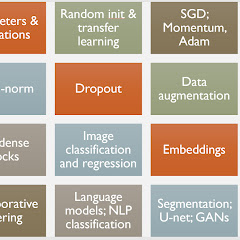
- Apply deep learning to computer vision, natural language processing, tabular analysis, and collaborative filtering problems
- Use PyTorch, the world’s fastest growing deep learning software, together with popular libraries such as fastai, Hugging Face Transformers, and gradio
You don’t need any special hardware or software — we’ll show you how to use free resources for both building and deploying models. You don’t need any university math either — we’ll teach you the calculus and linear algebra you need during the course.
- Introduction
- What has changed since 2015
- Is it a bird
- Images are made of numbers
- Downloading images
- Creating a DataBlock and Learner
- Training the model and making a prediction
- What can deep learning do now
- Pathways Language Model (PaLM)
- How the course will be taught. Top down learning
- Jeremy Howard’s qualifications
- Comparison between modern deep learning and 2012 machine learning practices
- Visualizing layers of a trained neural network
- Image classification applied to audio
- Image classification applied to time series and fraud
- Pytorch vs Tensorflow
- Example of how Fastai builds off Pytorch (AdamW optimizer)
- Using cloud servers to run your notebooks (Kaggle)
- Bird or not bird? & explaining some Kaggle features
- How to import libraries like Fastai in Python
- Best practice - viewing your data between steps
- Datablocks API overarching explanation
- Datablocks API parameters explanation
- Where to find fastai documentation
- Fastai’s learner (combines model & data)
- Fastai’s available pretrained models
- What’s a pretrained model?
- Testing your model with predict method
- Other applications of computer vision. Segmentation
- Segmentation code explanation
- Tabular analysis with fastai
- show_batch method explanation
- Collaborative filtering (recommendation system) example
- How to turn your notebooks into a presentation tool (RISE)
- What else can you make with notebooks?
- What can deep learning do presently?
- The first neural network - Mark I Perceptron (1957)
- Machine learning models at a high level
- Homework
Thanks to bencoman, mike.moloch, amr.malik, and gagan on forums.fast.ai for creating the transcript.
Thanks to Raymond-Wu on forums.fast.ai for help with chapter titles.
Why it's here
2 people recommend this
What people say. Highly recommended as one of the best, most hands-on introductory courses for learning practical deep learning.
u
ujjwalgroveron Hacker News • Recommends
On “Ask HN: What's the best lecture series you've ever seen?”
Practical deep learning for coders (2022 edition) By Jeremy, who is the founding researcher at fast.ai. Three things I love about this series 1. Jeremy seems like a power user of Jupyter notebook and uses them beautifully to run the lectures. The book on fastai is also written in Jupyter notebooks. 2. The lectures are super hands on - Jeremy actually fires up a jupyter notebook and runs code which often surprises him 3. I love how he describes he deep dives into a specific Kaggle competition. Describes in great detail his own attempts at getting up the leaderboard. It's almost like watching a poker player reveal her decision process before they make a move. link to this video
On “Riffusion – Stable Diffusion fine-tuned to generate Music”
I'm super excited about the Audio AI space, as it seems permanently a few years behind image stuff - so I think we're going to see a lot more of this. If you're interested, the idea of applying Image processing techniques to Spectrograms of audio is explored in brief in the first lesson of one of the most recommended AI courses on HN: Practical Deep Learning for Coders link to this video
> weights of a model, that a domain expert can tweak by hand This sounds similar to how image recognition was done before deep learning 11link to this video