Skip to content
0:00 / 0:00

#cellularautomata#lenia#artificiallife

Lenia: Expanded Universe 1080p

Bert Chan (Azul)

3.4K subscribers • 1 video on Hallway

YouTube

Intermediate. Assumes working knowledge.

83K views6 years ago2 recommendations

Computer scienceComputation and complexity

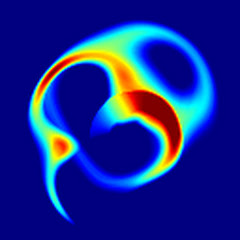
Bert Chan demonstrates Lenia, a continuous cellular automata system that produces life-like, self-organizing, and highly symmetric patterns.

How life-like can artificial life be? Lenia is a continuous cellular automata, a form of artificial life, that was evolved from Conway's Game of Life. Previously we showed that Lenia can produce a large variety of self-organizing, highly symmetic patterns. Now we take Lenia to higher dimensions and multiply the system's complexity. This opens up a whole new world of exploding diversity and new emergent phenomena, including: self-boundary, self-replication, internal division of labor, phenotypic polymorphism, and strange 3D/4D physiology. Sometimes it's hard to tell we are looking under a microscope or at a computer simulation. Paper: arxiv.org/abs/2005.03742 Code: github.com/Chakazul/Lenia Music: soundcloud.com/morusque/tissage-nautique Seminar talk: (coming soon) Previous video: youtube.com/watch?v=iE46jKYcI4Y Website: chakazul.github.io/

Why it's here

2 people recommend this

What people say. Recommended as a beautiful example of continuous cellular automata and artificial life simulations.

u/SirLichin r/compsci • Recommends

On “Are there any other ideas/simulations in theoretical CS that have had the same impact as Conway’s Game of Life?”

I assume you are talking about *cultural* impact. You got some good answers here, such as Boids algorithm, Mandlebrot set, Fractals in general. I think these are the real winners in terms of cultural impact, but here are some more stuff you might be interested in: - Ant simulations - Slime mold simulations - The general concept of higher-dimension continuous cellular automata As an aside: GOL isn't actually that impactful, compared to stuff like cryptography, GANs, or really anything applied. It's a fascinating and culturally significant thing, but it's not like the crowning achievement of even Conway himself.

u/currentscurrentsin r/compsci • Recommends

On “Cellular Automata rule 345/2/4 on the generations algorithm generates structures, glider guns and many marvelous things from the initial state of just 2 adjacent cells.”

Have you looked at continuous cellular automata? It's the same idea, but with an update rule that works on real numbers instead of discrete values. The resulting patterns look much more organic, and because it's differentiable you can use gradient descent to search for interesting "lifeforms". https://chakazul.github.io/lenia.html

u/currentscurrentsin r/compsci • Recommends

On “do you think computer science is beautiful?”

A lot of computer science is about how to build effective programs. There's some functional beauty in data structures and algorithms, but it isn't much like the humanities. But also in computer science, there's the study of *computation as a phenomena*. Fractals, cellular automata, emergence, chaos theory, etc. There's real beauty in there, like the infinite complexity of the Mandelbrot Set or the strange movements of continuous cellular automata. How does complex behavior - like you - arise from simple rules, like the laws of physics? This is a computer science question, through the lens of complex systems theory.