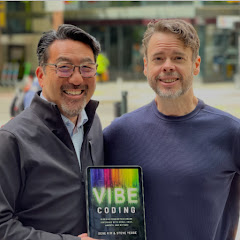
Steve Yegge demonstrates Efrit, a tool that allows Claude to control Emacs, run shells, and orchestrate complex tasks across the ecosystem.
In this rather mind-blowing episode of Vibe Coding with Steve and Gene, Steve demonstrates Efrit — giving Claude full access to control Emacs. What starts as a simple show-and-tell quickly melts Gene's brain. Steve shows how Claude can get Emacs do basically anything: open info pages, count files, start shells, even generate a Mandelbrot fractals in a buffer.
By doing this, the AI has complete access to Emacs's 50-year ecosystem of packages and can orchestrate complex tasks across multiple windows and processes. You can hear Gene's constantly trying to ask questions so he can get his head around what Steve built.
Gene also asks Steve to apply the vibe coding loop from the book to this project: Steve emphasizes that "the plan is everything" - proper planning solves most AI coding problems, including instruction following failures, reward hacking, and context window limitations. His approach involved months of iterative refinement, constantly catching the AI when it tried to "cheat" (like building haiku detectors instead of just writing haikus), and gradually building up a stable system that could handle multi-turn conversations reliably. The breakthrough came when he re-architected the entire system around Thorsten Ball's vision of simple agent loops.
We suspect you will find this episode to be mind-expanding, when you can control software in a way that is truly conversational and alive — beyond what MCPs can do today. Steve's system demonstrates how vibe coding can create genuinely transformative new things that the world has never seen. As long as you can articulate your vision clearly, are willing to iterate, know have a sense of where the AI boundaries of capabilities are.
github.com/steveyegge/efrit
Pre-order the book here: amazon.com/Vibe-Coding-Building-Production-Grade-Software/dp…
Introduction
Steve's Project: Efrit in Emacs
Demonstration of Efrit
Technical Deep Dive: Building Efrit
The Vibe Coding Loop Explained
The Importance of Planning in Vibe Coding
Adding Context to Coding Agents
Challenges with Multi-Turn Interactions
Re-Architecting the System
Creative Vision for Software Development
Voice Dictation and Testing Challenges
Integration Tests and Permission Checks
Context Window Limitations
Reward Hacking in AI
Instruction Following Issues
Show and Tell: Integration Test Results
Conclusion and Future Plans
Why it's here
1 person recommends this
What people say. Recommended as an impressive demonstration of building practical agentic loops by giving an LLM direct access to a running editor process.
r
refseton Hacker News • Recommends
On “Designing agentic loops”
For anyone else curious about what a practical loop implementation might look like, Steve Yegge YOLO-bootstrapped his 'Efrit' project using a few lines of Elisp: link And for more context on Efrit this is a fun watch: "When Steve Gives Claude Full Access To 50 Years of Emacs Capabilities" link to this video
…i was able to get great results on such niche operations already from anthropic's opus 4.5 models but even grok or deepseek was pretty helpful already last summer. steve yegge's efrit takes this to a whole new level, by letting the LLM interrogate your running Emacs process live for documentation or function source code: link he demoed it here: link to this video…